Jewelry Insurance Issues

February 2001

JEWELRY INSURANCE ISSUES (formerly IM News), provides monthly insight and information for jewelry insurance agents, underwriters and claims adjusters.

Subscribe to
Jewelry Insurance Issues

Table of Contents

Click on article titles in red

2008

Garnet—and Its Many Incarnations - January

Organic Gems - February

Do Your Jewelry Insurance Settlements Make You Look Bad? - March

Don't Be Duped by Fake JISO Appraisal - April

Diamonds in the Rough - May

The Cultured Club - June

Sapphire—Gem Superstar - July

It’s a Certified Diamond! 
— But who's saying so?
- August

FTC Decides: Culture Is In! - September

Paraiba Tourmaline – What's in a Name? - October

How Fancy is Brown? - November

2007

Moissanite's New Spin - January

Online Jewelry - Buying and Insuring - February

Blood Diamonds - March

Damaged Jewelry, Don't Assume!- April

Chocolate Pearls - May

Appraisal Puff-Up vs Useful Appraisal - June

It's Art, but is it Jewelry?
- July

Diamonds Wear Coats of Many Colors - August

DANGER! eBay Jewelry "Bargains" - September

TV Shopping for Jewelry - October

Enhanced Emerald: clever coverup - November

How do you like your rubies —
leaded or unleaded?
- December

2006

The New Platinum: A Story of Alloys - January

Ruby Ruse - February

How Big are Diamonds Anyway? - March

GIA Diamond Scandal
Has Silver Lining for Insurers
- April

Watch Out for Big-Box Retailers Insurance Appraisals - May

Mixing It Up: Natural and Synthetic Diamonds Together - June

Tanzanite - Warning: Fragile - July

Red Diamonds - August

Inflated Valuations & Questionable Certificates - September

Emeralds - October

Where Do Real Diamonds Come From? - November

Counterfeit Watches — The Mushroom War - December

2005

The Lure of Colored Diamonds - January

Synthetic Colored Diamonds - February

Watches: What to Watch for - March

When is a Pear not a Pair? - April

The Truth About Topaz - May

White Gold: How White is White? - June

One of a Kind — or Not - July

Jewelry in Disguise - August

Valued Contract for Jewelry? Proceed with Caution! - September

Antiques, Replicas and All Their Cousins
October

Grading the Color of Colored Diamonds
November

New GIA Cut Grade for Diamonds - December

2004

Synthetic Diamonds — and Insuring Tips - January

Bogus Appraisals and Fraud - February

A Picture is Worth Thousands of Dollars - March

Don't be Duped by Fracture Filling - April

Gem Scams Point to Need for Change - May

What is a Good Appraisal - June

4Cs of Color Gemstones - July

Gem Laser Drilling: The Next Generation - August

Why Update an Appraisal? - September

When to Recommend an Appraisal Update or a Second Appraisal - October

Secrets of Sapphire - November

Will the Real Ruby Please Stand Up - December

2003

Mysterious Orient:
A Tale of Loss
- January

Bogus Diamond Certificates and Appraisals - February

Can Valuations be Trusted? - March

Spotting a Bogus Appraisal or Certificate - April

Counterfeit Diamond Certificates - May

Case of the Mysterious "Rare" Sapphires - June

Politically Correct Diamonds - July

Name Brand Diamonds - September

Princess Cut: Black Sheep of Diamonds - October

Reincarnate as a Diamond - November

Synthetic Diamonds - December

2002

Irradiated Mail/Irradiated Gems - January

Fake Diamonds (Moissonite) - February

GIA Diamond Report - March

AGS and Other Diamond Certificates - April

Colored Stone Certificates - May

Damaged Jewelry: Don't Pay for Nature's Mistakes - June

The Case of the "Self-Healing" Emerald - July

Mysterious Disappearance: Case of the Missing Opals - August

The Discount Mirage - September

What Can You Learn from Salvage? - October

Gaining from Partial Loss - November

Year in Review - December

2001

Colored Diamonds - January

Good as Gold - February

Disclose Gem Treatments - March

FTC Jewelry Guidelines - April

Myths Part I: Each Piece is Unique - May

Myths Part II: Myths, Lies, & Half-Truths - June

New Trend: Old Cut Stones - October

The Appraisal Process - November

Year in Review - December

2000

Deceptive Pricing - January

Gems - Natural or Manmade - February

Jeweler/Appraisal Credentials - March

Fracture Filling - April

Salvage Jewelery - May

Gem Treatments - June

Don't Ask/Don't Tell - A Buying Nightmare - July

Laser Drilling of Diamonds - August

Jeweler Ethics or the Lack Thereof - September

Gem Scam - October

The Truth about Clarity Grading - November

Year in Review - December


We'll be glad to notify you when the Jewelry Insurance Issues is available each month. Sign up for your FREE SUBSCRIPTION to Jewelry Insurance Issues.

Visit the rest of the JCRS site:  www.jcrs.com

Good as Gold

Even a professional jeweler can't tell the difference between 10 karat, 14 karat and 18 karat gold, just by looking at it. What's an untrained customer—or insurer—to do?

Gold jewelry is sold just about everywhere—on TV shopping channels, through mail-order catalogs, in department stores, flea markets and fine jewelry stores. Gold earrings or a simple chain necklace can be found in a wide range of prices. What makes the price differences? How is value determined?
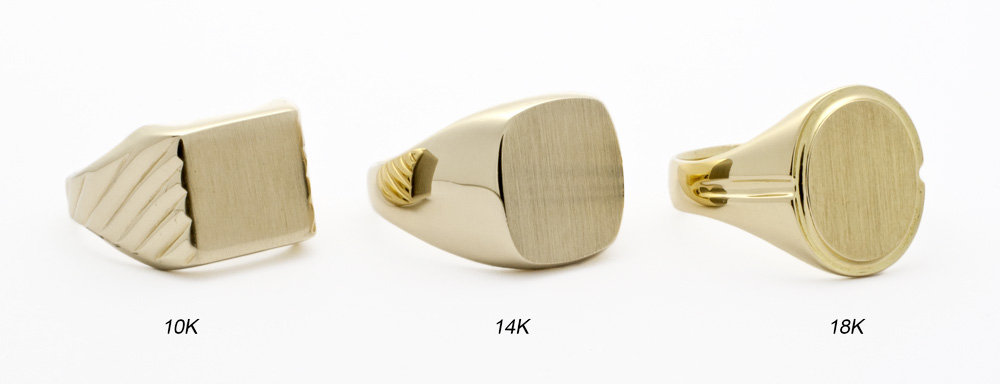
Karatage. Karatage describes the gold content of jewelry. Pure gold is stated as 24 karat (24K). Gold in its pure state is seldom used for jewelry because it is too soft. It is combined with other metals, or alloys, to produce a more durable metal. The finest gold jewelry is 18 karat. This means the piece is 18/24 or 75% pure gold (and 25% alloy).
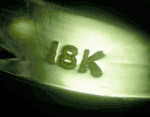
U.S. law does not require labeling the gold content of jewelry. However, the law does come into play once the jewelry is labeled "gold." To be called "gold," a piece must be at least 10K (or 10/24) gold. This law also applies to gold-filled, gold plate, and gold vermeil—all of which involve bonding gold to another metal. Karatage is usually stamped on the piece, since it is a selling point and something the manufacturer wants to be known. Buyers and insurers should be suspicious of any jewelry described as "gold" that is not stamped with the karatage.

Trademark. Any jewelry that is stamped with the karatage (such as "14K") must also bear the manufacturer's trademark or hallmark. The purpose of this law is that if underkarating occurs, the trademark helps trace the offending item to its source. While this is an old law, many jewelry manufacturers are only now beginning to include their trademarks. The manufacturer's mark usually appears as a symbol, rather than a name, to save space on the small jewelry item. The name of the manufacturer should be given on the appraisal.

Underkarating. The most reliable test for determining karatage is the fire assay, in which a piece of the gold is melted down and separated from its alloys. Since this destroys the jewelry, it is used only in cases where fraud is suspected. In general, jewelers and their customers rely on the manufacturer's statement of the gold's purity. This is why knowing the manufacturer is an important part of valuing gold jewelry.

Workmanship. The workmanship of gold jewelry is crucial to its valuation. Today's jewelry is usually machine-processed in some way. Modern methods have eliminated much of the time-consuming handwork, making fine jewelry accessible to more people. Expect the appraisal to list the jewelry's workmanship, using terms such as cast, die-struck, cast & hand assembled, machine-made or, in uncommon instances, handmade. Within each category there are also differences in quality. For example, detail and definition tend to get lost as manufacturers copy each other's work.
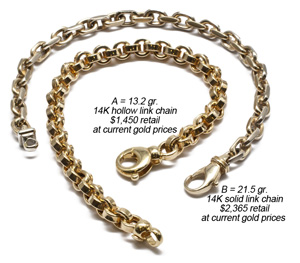
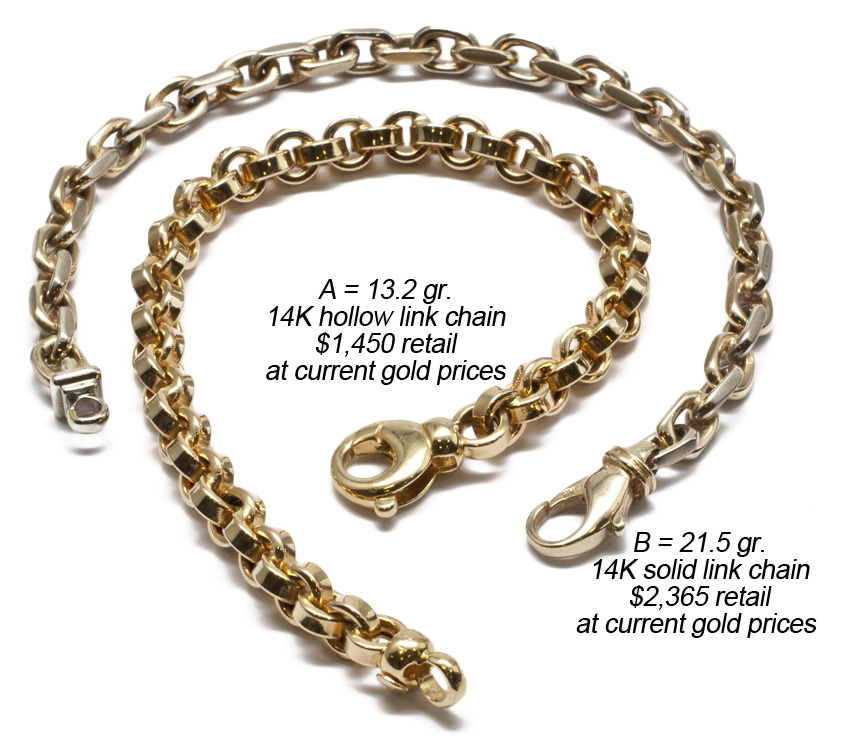
Weight. Two gold chains of the same karatage and workmanship will vary significantly in price if one weighs 2 grams and the other 10 grams. Jewelry worn on the wrist or hand, such as a ring, bracelet or charm, takes a lot of abuse in everyday wear; such a piece should have some weight to it for practical reasons, as well as for value. Sometimes retailers quote price-per-gram in their sales promotions, making it easy for customers to comparison shop. Most national and local jewelry stores are prepared to weigh gold jewelry, while flea market vendors are not.

See the chart for gold prices, historic and recent.

FOR AGENTS & UNDERWRITING

An appraisal for jewelry containing gold should include karatage, manufacturer and style number, workmanship, and weight of the piece.

Appraisals often lack the manufacturer and style number. Jewelers conceal this information to give the impression the piece is unique and also to prevent customers from comparison shopping. However, this is exactly the information the adjuster needs to price a replacement and you should insist on it in the appraisal.

You might point out to a policyholder that the law requires the manufacturer's identity for the customer's protection. If the jewelry does not bear the manufacturer's trademark, there is reason to be suspicious of the stated karatage (no one is taking responsibility for the truth of the karatage marking). If the jewelry bears a trademark but the jeweler is reluctant to disclose the owner of the trademark, the customer might suspect an inflated price (because the customer cannot comparison shop).

A professional jewelry retailer will be able to weigh gold jewelry. Since weight is an important determinant of value, be sure this information is on the appraisal.

FOR CLAIMS

If there is inadequate information in the insurance files, perhaps a poor appraisal or just a sales receipt, try calling the jeweler to see if he can provide more information. Jewelers often keep notes on the pieces they carry and sell. (However, you may get no cooperation from the jeweler. Or he may embellish the quality of the piece, with the intention of helping the customer, so use caution.)

If you know where the item was purchased, you can analyze the type of merchandise the store normally carries. For example, mall chains such as Zale's carry mostly cast, light weight jewelry with lesser quality workmanship. If the sales receipt carries little information, you can fill in the blanks with factual assumptions based on the store's general merchandise.


Subscribe to Jewelry Insurance Isssues

Sponsored by Jewelry Insurance Brokerage of North America

For Insurance professionals: 8 hours CE credit. Jewelry insurance is the key to cross-selling opportunities to commercial insurance. Learn how to improve loss ratios and take advantage of value-add services for your agency.