
When Is a Pear Not a Pair?
 Losing
an earring is a common enough occurrence. If you’re inclined to think
earring coverage automatically falls under broad form Pair & Set, think
again!
Losing
an earring is a common enough occurrence. If you’re inclined to think
earring coverage automatically falls under broad form Pair & Set, think
again!
Many jewelry items come in pairs or sets, such as earrings, wedding ring sets, or matching sets of necklace and earrings. Should they be covered by a standard or broad form pair & set clause? We recommend limiting jewelry to standard pair & set coverage, and not using the broad form. Here’s why.
If some piece of a set is lost or damaged, a broad-form pair & set clause (sample clause ). requires paying the full amount for the entire set. This inevitably leads to overpayments. The settlement cost is further compounded if the insurer is writing a valued contract.
A standard pair & set clause (sample clause ), on the other hand, allows the insurer to restore the set to its original value by repairing or replacing the damaged or lost piece. Can part of a set be separated out like that? Can a repaired or replaced item really match the original set? Emphatically, Yes.
Here are a few examples from our files.
Duplication Is Easy
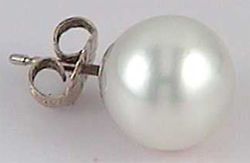
Many people (insurers as well as consumers) think that each piece of jewelry is unique, and that part of a matched set could certainly not be duplicated. Often insurers decide to pay the scheduled amount without even seeing the jewelry. Here’s an instance when duplicating the lost earring would obviously be easy. The cost to the insurer would have been $150. Instead the company paid the full limit of liability for the pair.
Overpayment: $1,250
Just Replace the Stone
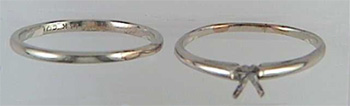
Both rings were claimed as a damaged “wedding set” when a stone was lost from the engagement ring. In jeweler terminology, a wedding set consists of two rings designed to fit together such that each would be incomplete without the other. These two are just separate bands and should not have been treated as a set. In any case, the lost stone could have been replaced for a fraction of the scheduled amount (for both rings) paid out by the carrier.
Overpayment: $2,457
Never Assume It Can’t Be Done
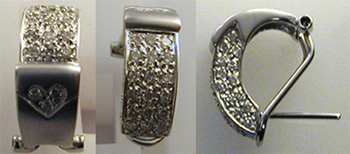
This white gold earring, shown in three views, may appear to the insurer as intricate and tricky to duplicate, with its “forty-seven bead-set round brilliant diamonds.” But a jeweler could have supplied its mate for a bit over $300. Instead, the insurer paid the policy limit for the pair.
Overpayment: $1,684
It’s Not Pair & Set
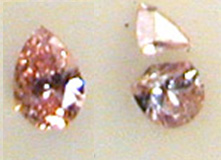
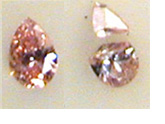
These two pear-shaped pink diamonds were on either side of a center stone in a ring. One of the diamonds became damaged. The insurer treated the loss as pair & set, paying out $26,500 to replace both stones. This was an unfortunate, and expensive, decision for three reasons:
- This loss was not a pair & set at all. It was simply one damaged stone, and a match for the undamaged diamond could have been made.
- Analysis of the appraisal showed that the ring’s value was inflated by about $10,000. A jewelry expert working for the insurer could have examined both the jewelry and the appraisal, and recognized this discrepancy before the settlement was made.
- The damaged diamond could have been replaced for about $5,000.
Overpayment: $21,430
Prelude to a Scam
The “King Solomon’s Gems Collection” started with one large uncut, unpolished sapphire found in a shoebox. Over a few years eleven more stones were added, until the group was eventually appraised at more than $160 million. When a broker attempted to insure the batch, asking for broad form pair & set coverage, jewelry insurance experts sensed a setup for fraud. They suspected that one of the stones would eventually “mysteriously disappear” and the insurer would be out $160 million.
Their caution was well-founded. It turned out the stones were grossly overvalued, and the appraiser lost his American Gem Society membership. There were several red flags in this case, but one of them certainly was that an accumulation of uncut stones should for no reason be insured as a “set.”
An Unusual Case
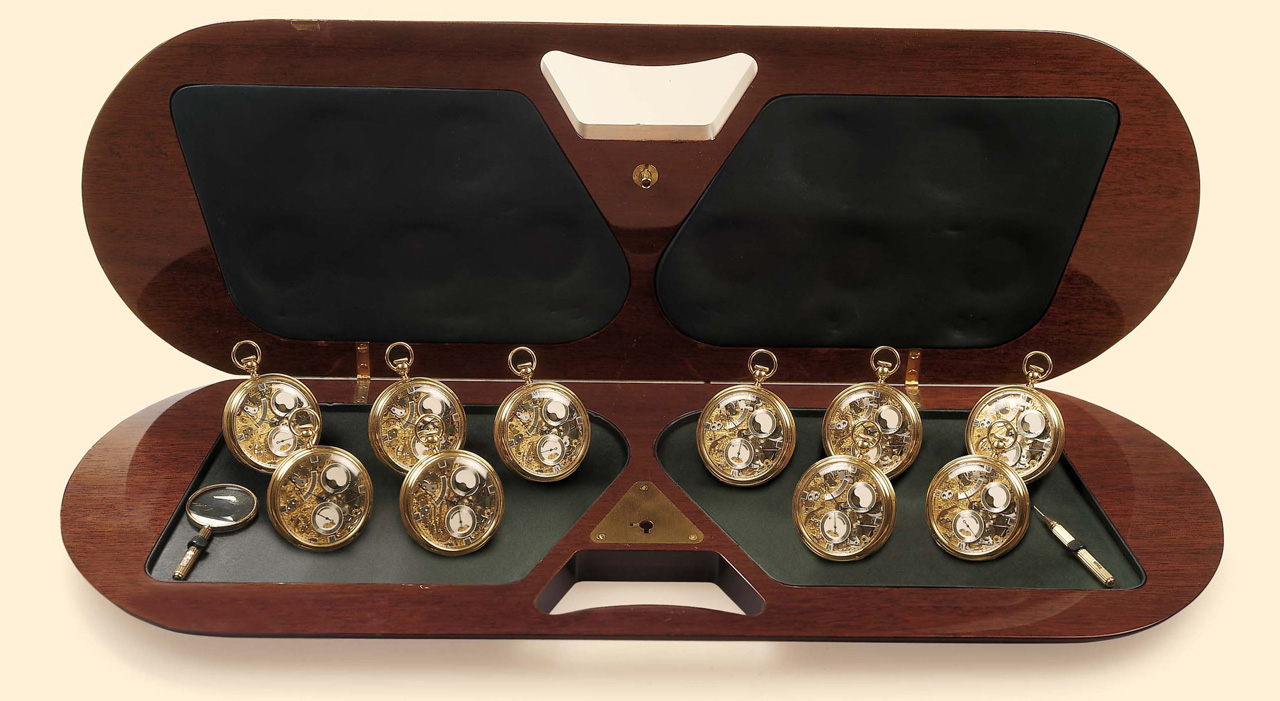
Click to enlarge
Occasionally a situation arises where broad form pair & set coverage should be considered. These 10 watches were made in 1994 on special order from an Oriental royal family. Their design is based on early self-winding watches created by the House of Breguet in France. Made of 18-carat gold and elaborately fashioned, each watch represents a different animal motif inspired by the Chinese zodiac and folklore. The set is unique.
Insuring these watches would call up several considerations: Since they were produced in 1994, perhaps the manufacturing company would still be in business at time of loss and able to make a replacement (or perhaps not). The cost of replacing one watch would be more than one-tenth the value of the set, but how much more? If one watch were lost and irreplaceable, how would that affect the value of the set?
In this situation, a carrier might consider broad form pair & set coverage, but such cases are rare.
FOR AGENTS & UNDERWRITERS
We recommend limiting jewelry coverage to standard pair & set coverage. In the vast majority of cases, making a mate or even just replacing a lost stone will restore the set to its previous value.
Be sure to have on file a detailed appraisal, preferably ACORD 78/79, as well as a photograph of the jewelry.
FOR ADJUSTERS
Take advantage of the unique opportunity available when a loss occurs from a pair or set: Always have the remaining jewelry inspected by a jewelry expert working for you.
Such inspection:
- will elicit the best price for repairing or replacing a damaged or lost item.
- may reveal that damage was the result of inherent vice, for which the insurer is not responsible.
- will allow comparing the remaining jewelry with the existing appraisal, to ensure that the description is accurate and value not inflated.
Never assume that a mate cannot be made. Get the opinion of a disinterested jewelry expert.
Do not take the word of the original selling jeweler or of replacement companies. They are likely to encourage the assumption that duplicates cannot be made because it’s in their financial interest to sell a complete new set, rather than replace a single piece of the set.
Sample Clause:
Standard Pair & Set clause:
Pair, set or parts other than fine arts
- a. Loss to a pair or set
In case of a loss to a pair or set we may elect to:- (1) Repair or replace any part to restore the pair or set to its value before the loss; or
- (2) Pay the difference between actual cash value of the property before and after the loss.
- b. Parts
In case of a loss to any part of covered property, consisting of several parts when complete, we will pay for the value of the part lost or damaged.
Broad Form Pair & Set clause:
If the scheduled article or property is a pair or set, or consists of several parts when complete, we will pay the full amount shown in the Schedule for that pair, set or complete article. At our request, you will surrender that article or property to us if not lost or stolen.
Broad Form Pair & Set clause:
If the scheduled article or property is a pair or set, or consists of several parts when complete, we will pay the full amount shown in the Schedule for that pair, set or complete article. At our request, you will surrender that article or property to us if not lost or stolen.
Standard Pair & Set clause:
Pair, set or parts other than fine arts
- a. Loss to a pair or set
In case of a loss to a pair or set we may elect to:- (1) Repair or replace any part to restore the pair or set to its value before the loss; or
- (2) Pay the difference between actual cash value of the property before and after the loss.
- b. Parts
In case of a loss to any part of covered property, consisting of several parts when complete, we will pay for the value of the part lost or damaged.
©2000-2024, JCRS Inland Marine Solutions, Inc. All Rights Reserved. www.jcrs.com
Subscribe to Jewelry Insurance Issues
