
WHITE GOLD: How White Is White?
White gold is all the fashion, but what is it exactly? How white is it, and does it stay white?
The 3 Precious "Whites"
The three precious metals, platinum, silver and white gold, are all "white." But there are differences between them.
Silver is the whitest of the precious metals and the most lustrous. It is also the least expensive, currently selling for about $7 a troy ounce. Silver's major drawbacks are that it is softer and less durable than the other two precious metals, and that it tarnishes.
Platinum, also white in color, is a much harder, denser material. Though more difficult to fabricate due to its high melting point, it provides an ideal material for securely setting expensive stones. However, platinum is also far more costly, currently priced at approximately $900 per troy ounce.
Falling between the two in price is gold — which is basically yellow. White gold was developed in the 1920s as a substitute for the more expensive platinum. Gold currently sells for about $400 per troy ounce.
Making Gold White
Jewelry made of white metal is the current fashion, so white gold has become popular. But gold jewelry is available in many other colors, such as green, pink, and even blue. These various colors (including yellow and white) are determined by alloys, metals added to strengthen the gold and make it more suitable for jewelry.
White gold has traditionally been created by adding copper, nickel and zinc, all inexpensive alloys. Varying the amount of these ingredients produces different shades of white. Manufacturers of jewelry often add a coating of rhodium to the finished piece to make its off-white color appear white.
But: as the rhodium wears off, the jewelry appears to be turning yellow. "I've had people throw rings at me across the counter," said one jewelry retailer of her more irate customers. Many buyers aren't told that maintenance of their white gold jewelry means getting it replated every year or so.
An alternative recipe for producing white gold calls for alloying it with copper, silver and palladium. These alloys are more expensive than nickel and zinc, but they produce a whiter white, so the jewelry doesn't need to be plated with rhodium.

click for larger image
A "whiter white"? The jewelry industry recently completed a chart comparing shades of white gold, as a move toward developing a standard classification system and reference tool. The chart is based completely on appearance (rather than on, say, the alloys used). The idea is that retailers can specify whiteness grade when they order jewelry.
Only the top two grades are considered white enough not to require rhodium plating. Customers buying a less expensive white gold, which has been rhodium-plated, should be warned that their jewelry needs replating every year or so. In many cases, they are not. The jeweler is reluctant to disclose this hidden cost (replating) of the less expensive white gold.
What Determines Gold Jewelry's Value?
"White gold" on an appraisal is descriptive. It says nothing about quality. White gold jewelry is not necessarily more or less valuable than yellow gold.
When valuing gold jewelry, the appraiser considers the following qualities, all of which should appear on the appraisal:
Karatage. The value of gold — white, yellow or any other color — derives from its karatage. The term karat is used to express the purity of gold when it is alloyed. Each karat represents 1/24 of pure gold. Thus, the gold content of an 18 kt jewelry item is 18/24 (or 75%) pure gold. The rest is alloy. This is why 18 kt gold is worth more than 14 kt gold.
Under U.S. law, jewelry that is called "gold" or "karat gold" must be at least 10 kt gold. Buyers and insurers should be suspicious of any jewelry described as gold that is not stamped with the karatage.
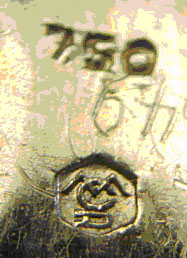
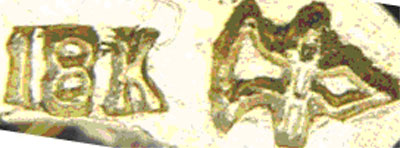
Trademark. Federal law also requires that any jewelry stamped with karatage (such as "14 kt") also bear the manufacturer's trademark or hallmark. (See the law.) The manufacturer's mark usually appears as a symbol, rather than a name, due to limited space on jewelry items. These marks can be quite mysterious and esoteric, but the jewelry appraisal and sales receipt should list the manufacturer's full name (as opposed to describing the trademark symbol).
Examples (click to enlarge):
|
USA trademark for Jabel |
European trademark firm |
|
USA trademark for Jones and Woodland, a division of Krementz & Co |

Workmanship. Most jewelry today is machine-processed in some way. Expect to see on the appraisal the jewelry's workmanship, using terms such as cast, die-struck, cast & hand assembled, machine-made or, in rarer instances, handmade.
Weight. The amount of gold used is also crucial. Two gold chains of the same karatage and workmanship will vary significantly in price if one weighs 8 grams and the other 20 grams. Jewelry worn on the wrist or hand, such as a ring or bracelet, takes a lot of abuse in everyday wear; such a piece should have some weight to it, for practical reasons as well as for value.
Many jewelry retailers are not willing to reveal the weight of gold jewelry, most likely to prevent comparison shopping. They may even say they have no scale. The customer should insist on knowing the weight, as this is important to valuation. And the weight should be listed on the appraisal.
FOR AGENTS & UNDERWRITERS
An appraisal for any jewelry containing gold should include
- karatage
- manufacturer
- style number
- workmanship
- weight
Be suspicious if jewelry is called "gold" but the manufacturer's name is not given on the appraisal. Jewelry stamped with karatage must, by law, bear the manufacturer's trademark. The appraiser should list the owner of that trademark (that is, the manufacturer) on the appraisal.
You might point out to a policyholder that the law requiring the manufacturer's identity is for the customer's protection. If the jewelry does not bear the manufacturer's trademark, there is reason to be suspicious of the stated karatage (since no one is taking responsibility for the truth of the karatage marking). If the jewelry bears a trademark but the jeweler is reluctant to disclose the owner of the mark, the customer might suspect an inflated price (because without knowing the manufacturer, the customer cannot comparison shop).
For a detailed appraisal, it is best to rely on the insurance industry's standard Jewelry Appraisal form (ACORD 78/79), written by a Certified Insurance Appraiser™.
FOR ADJUSTERS
If the appraisal is not on the insurance industry's standard Jewelry Appraisal form (ACORD 78/79), use Jewelry Appraisal and Claim Evaluation (ACORD 18) to check that all necessary information is given.
If there is inadequate information on file, perhaps a poor appraisal or merely a sales receipt, a jewelry insurance expert may be consulted before settling the claim.
Note: A rhodium coating that wears off is considered normal wear and tear, for which the insurer is not liable.
©2000-2024, JCRS Inland Marine Solutions, Inc. All Rights Reserved. www.jcrs.com
Subscribe to Jewelry Insurance Issues
