
Big-Box Jewelry Retailers:
Watch Out for Their Insurance Appraisals
Where would you look for fine jewelry — Tiffany or Costco?
The Internet or your local jeweler? Who gives the best price?
Is price the only concern?
Big-box stores are not the first places you'd think to shop for jewelry, especially expensive jewelry. But that may be changing.
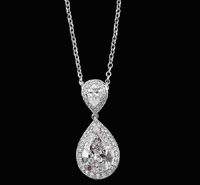
Sam's Club, a division of Wal-Mart, has been selling diamonds for more than 20 years. Last year they began carrying big-ticket jewelry, like this one-of-a-kind pink diamond pendant for $560,000.
Sale Price: $560,000 |
 |
Replacement Value: $813,000??!! |
- 5.07 ct. t.w. of diamonds
- 3.74 ct., pear-shaped natural Fancy Purple Pink diamond
- .5 ct. pear-shaped white diamond
- Mounting: Handmade in Platinum and 18K gold
- Diamond Color: Fancy Purple Pink (3.74 ct. diamond); E (.5 ct. diamond)
- Diamond Clarity: VS2 (3.74 ct. diamond); VVS1 (.5 ct. diamond)
- GIA certificate included
- IGI Retail Replacement Value: $813,000 [emphasis added]
Wall-Mart is known for its broad range of low-priced merchandise. It is a destination for one-stop shopping. "Loyalist" customers, as the company terms them, visit the store 64 times a year and spend 77% of their grocery dollars there.
While keeping this reliable customer base, Wal-Mart has begun carrying more upscale merchandise to appeal to "the Selective shopper," the buyer looking for specialty items, who shops for value rather than just low price. It wants the public to see the store as not only a place to stock up on toilet paper and dog food, but also as a viable high-end jeweler.
Costco, too, is appealing to more affluent shoppers. Along with original paintings and etchings by Picasso, priced at more than $1 million each, it is offering quality jewelry.
Good Morning America recently ran a piece comparing shopping for diamond jewelry at Costco vs. shopping at Tiffany & Co. After the sales, an independent appraiser declared that in each purchase the buyers got exactly what the store said they were getting. The markup at Tiffany's was significantly greater, but the show stated that "the Costco experience was less romantic" than shopping at Tiffany's and the choices were fewer.
Then there's the Internet experience. Big-box stores join a host of online jewelry retailers, selling everything from the almost worthless right on up to whatever a buyer can afford to pay. Online retailers can offer a huge selection because they needn't house the stock. They can special order anything a customer wants and have it drop shipped to the client. This lack of overhead allows for very low prices.
Many large retailers, including big box outlets, jewelry chains, and Internet sites, offer "certificates" with their diamond jewelry. These documents often carry grossly inflated valuations. For the pendant pictured above, notice that the jewelry comes with an IGI certificate setting its replacement value at $813,000 – 45% higher than the purchase price.
Such valuations assure buyers they are paying well below the jewelry's true worth. Although the jewelry may (or may not) be accurately described, the bogus valuation is meant to lure the customer and perhaps defraud the insurer.
How does a brick-and-mortar store compete?
One well-known jeweler, whose store is a destination for customers from all over the country, confronts the Internet challenge on its own terms. When a potential customer comes in saying, "I've done my research, I've found such-and-such on the Net at such-and-such a price," the jeweler says, "Give me your credit card and I'll order it for you." The customer is taken aback. He wants more from the jewelry store — personalized attention, a professional's expertise, some time in a luxurious setting where he can handle the merchandise and learn about it, a sense that his $2,000 (or $200,000) expenditure is an important event. But that glamorous setting, personal service, professional training and browsable inventory come at a price.
Big box means a smaller selection and no frills. Maybe the sales clerk is knowledgeable, maybe not. A couple aisles over, they're selling TVs or canned soda. As an official of Sam's Club put it, "We're not trying to cover up who we are. We're selling beautiful diamonds on a concrete floor."
The big box is also selling its name and its guarantee. If you're dissatisfied with your quarter-million dollar purchase, you can return it and get your money back. A small jewelry store, with a fraction of the big box's gross receipts, can't match that.
As for bargains: for all jewelry sales, it's buyer beware. The jewelry may not be as described. The seller may be untrained, mistaken, or just plain lying. The seller's valuation, or the "independent" appraisal he supplied, may be grossly inflated. An appraisal from the seller may exaggerate the jewelry's qualities and/or value.
It's best to have some general information about gems and jewelry before going shopping. We recommend using the GemQuote® Checklist for Comparison Shopping to compare qualities and prices at various retailers. And that advice also applies to the insurer buying replacement jewelry.
A last word of caution: if the jewelry does not come with the insurance industry's standard, a JISO 78/79 (formerly ACORD 78/79) appraisal, go to a Certified Insurance Appraiser™ immediately after the purchase to obtain such an appraisal and verify the jewelry’s qualities and valuation.
FOR AGENTS & UNDERWRITERS
Big-box retailers generally supply certificates with the jewelry they sell. Often these come from unreliable labs and carry inaccurate descriptions of the jewelry and notoriously inflated valuations. Such certificates are of little value.
Rely only on diamond reports/certificates from reputable gem labs, such as the Gemological Institute of America (GIA) and the American Gem Society (AGS). They describe the diamond but do not carry valuations. See Diamond Certificates and the April 2002 newsletter for more information on these diamond certificates.
Compare the appraisal with the sales receipt. A large discrepancy between purchase price and valuation indicates an inflated valuation. Such a discrepancy should be questioned even if the sale occurred years before, because jewelry can depreciate as well as appreciate in value
A reliable appraisal comes from a jeweler/appraiser who is a Graduate Gemologist and, preferably, a Certified Insurance Appraiser™. It should be prepared on the insurance industry's standard, the JISO 78/79 (formerly ACORD 78/79) appraisal form.
FOR CLAIMS
Carefully check and compare all documents on file, to gather as much information about the jewelry as possible. A simple tool for this purpose is the Jewelry Appraisal and Claim Evaluation form, JISO 18 (formerly ACORD 18).
Keep in mind that often appraisals supplied by the seller are sales tools
meant to impress the buyer. Their valuations may have little real-world basis.
If the appraisal shows a valuation considerably higher than the sales receipt,
suspect an inflated valuation.
©2000-2024, JCRS Inland Marine Solutions, Inc. All Rights Reserved. www.jcrs.com
Subscribe to Jewelry Insurance Issues
