
Mixing It Up:
Natural and Synthetic Diamonds
Together
Natural and synthetic diamonds can be good jewelry mates,
but you need to know who's who.
Natural and synthetic gems have a long history together. Since gems first began being made in a lab, they have been used in fine jewelry right along with mined gems. Many valuable period pieces are set with both natural and synthesized colored stones.
Synthesizing diamond, however, is a relatively new phenomenon. Synthetic diamonds for industrial use date from World War II, and it's only during the last decade or so that gem-quality synthetic diamonds have been available.
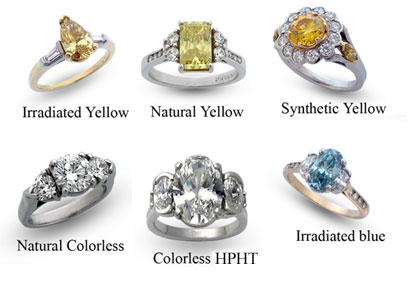
Why not use all natural diamonds?
Availability. While the supply of mined diamond rough is finite, the techniques for synthesizing diamond are getting better and cheaper. For one manufacturer, the technology is being driven by the hope of replacing silicon with diamond as a medium for computer chips. The potential financial rewards of revolutionizing the microprocessing industry insure a ready supply of gem-quality synthetic diamonds for the jewelry industry.
Matchability. For jewelry designs requiring many stones of similar size, finding natural diamonds of similar size can be difficult. On the other hand, acquiring size-matched stones of under a carat from diamond manufacturers is easy. For color matching, labs can readily produce colored diamonds or subject yellowish or brownish natural diamonds to treatments that add or improve color.
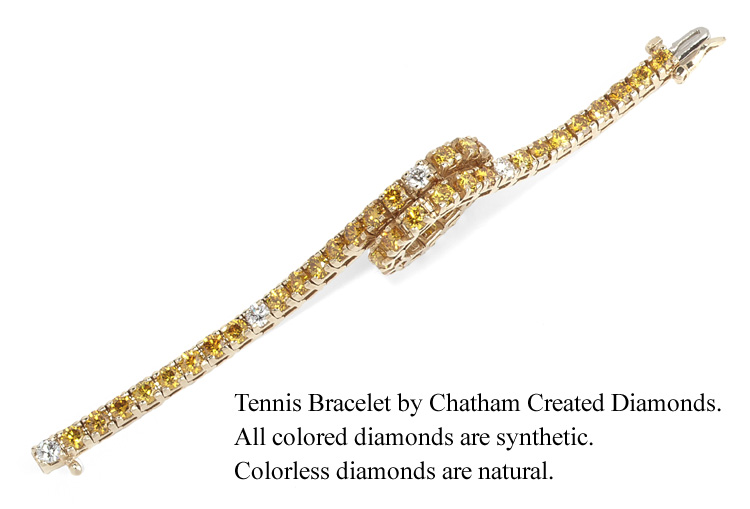 Color.
Natural diamonds of attractive colors, called fancies, are rare and extremely
expensive. To create the impact of color at a minimal price, jewelry designers
can use either synthesized colored diamond (created from scratch in a lab)
or natural diamond that has been lab-treated to enhance its color. Often the
synthesized diamond, or the color-enhanced diamond, is the centerpiece of
the jewelry, with tiny natural diamonds added as accents.
Color.
Natural diamonds of attractive colors, called fancies, are rare and extremely
expensive. To create the impact of color at a minimal price, jewelry designers
can use either synthesized colored diamond (created from scratch in a lab)
or natural diamond that has been lab-treated to enhance its color. Often the
synthesized diamond, or the color-enhanced diamond, is the centerpiece of
the jewelry, with tiny natural diamonds added as accents.
Price. Synthesizing gems is a fast-growing business, and high-quality colored diamonds from the lab are much cheaper than from the earth. Jewelry that would be prohibitively expensive if made with all natural diamonds becomes affordable when some of the stones, particularly colored diamonds, are synthetic.
Disclosure!
Within the jewelry industry, the issue of disclosure is still open to discussion. Some suppliers point out that synthesized diamond is real diamond—not an imitation. It has the physical and chemical properties of natural diamond, so why make a distinction? One jewelry designer insists that "the sophisticated consumer" will not care whether the stones came out of the ground or out of a lab.
However, the jewelry industry sets a far higher value on natural diamond than on synthetic. So for insurers the question is settled: disclosure of synthetic gems is essential.
Manufacturers usually make an effort to identify their stones as synthetic. They create a brand name, such as Gemesis, which they hope will in itself become a lure for consumers. Some may inscribe their name on the girdle of the diamond and provide a lab certificate stating that the stone is synthetic.
This is a good beginning, but as the diamond passes from hand to hand in the sales chain, inattention and fraud can enter in. A laser inscription can be easily polished off, as documented by the Gemological Institute of America (GIA) Gem Trade Lab. Documents identifying a synthetic stone may stray. Synthetic diamonds could be mixed in with batches of natural diamonds (similar to the recent scam involving rubies) and passed on as natural. Unfortunately, many jewelers are not professionally trained gemologists and could themselves be fooled by synthetics.
For the consumer, and the insurer, the best defense is a detailed appraisal from a Graduate Gemologist who is also a Certified Insurance Appraiser (CIA)™.
FOR AGENTS & UNDERWRITERS
In insuring jewelry that includes multiple diamonds, or colored diamonds, never assume they are all natural. Insist on an appraisal that explicitly states whether the gems are natural or synthetic, since the difference in valuation is great.
Alas, not all jewelers can distinguish synthetic from natural diamond. Be sure the appraisal comes from a Graduate Gemologist (GG), preferably one is also a Certified Insurance Appraiser (CIA)™.
Since natural colored diamonds are extremely expensive, a selling price that seems "too good to be true" is a major red flag. Do insurance to value (ITV) calculations to check for a large discrepancy between purchase price and replacement cost. Software is available that makes ITV calculations easy and guards against fraud.
Any colored diamond approaching .5 carat should come with a certificate from a reputable independent laboratory, such as the Gemological Institute of America (GIA) or the American Gem Society (AGS).
For all high-value jewelry, it is best to have two appraisals. At least one of them should be written on JISO 78/79 (formerly ACORD 78/79) Jewelry Appraisal, the insurance industry's standard, by a GG who is also a CIA™.
FOR CLAIMS
The word synthetic may have unpleasant associations for buyers, so gem manufacturers may use other terms to describe their lab-made gems. Look over the appraisal and diamond report for such terms as cultured, artificial, created, grown, and lab-grown.
Often synthetic diamonds are identified by the manufacturer's name, such as Gemesis, so carefully inspect the appraisal and sales documents for any brand names. Not all brand names signify a synthetic stone, so it's worth checking with your jewelry insurance expert as to what a particular brand name represents.
For jewelry with fancy colored diamonds, a price that's "too good to be true" is a major red flag. Do insurance to value (ITV) calculations to check for a large discrepancy between purchase price and replacement cost. Software is available that makes ITV calculations easy and guards against fraud.
Be suspicious if all you have to work with is an appraisal supplied by the seller. Gem qualities as well as the jewelry's valuation may be inflated.
Be suspicious if a certificate/report from a lab includes a valuation. Reputable grading labs report only on the qualities of the gem; they do not include valuation.
Any colored diamond approaching .5 carat should come with a certificate from a reputable independent laboratory, such as the GIA Gem Trade Lab or AGS Labs.
For damaged jewelry, have the jewelry inspected in a gem lab by a Graduate Gemologist who is a Certified Insurance Appraiser™. You want to be sure the replacement does not exceed the quality of the original. Especially, you don't want to replace a synthetic diamond with a natural.
©2000-2024, JCRS Inland Marine Solutions, Inc. All Rights Reserved. www.jcrs.com
Subscribe to Jewelry Insurance Issues
