
Counterfeit Watches —
the Mushroom War!
Fake watches are big business — and spreading rapidly. One manufacturer of luxury watches feels like he's engaged in "a mushroom war…. If you cut off one mushroom, there are three more the next morning."
Huge profits drive the counterfeiting of luxury goods. One estimate puts the profit margin at $10 per dollar invested, about equal to profits of the illicit drug trade.
Counterfeiting watches is a global networking business, and its products can be found at tourist resorts, internet sites, local jewelry shops, and a flea market near you.
Types of Fakes
There are basically two levels of counterfeit watch. The first is an extremely cheap imitation. The watch carries a luxury name but there's no effort made to copy details of the real watch. Sellers assume a customer who pays $30 on a street corner must know it's a fake, must know he's not getting a "real bargain" on a $2000 watch.
A higher-quality fake is one designed to closely resemble the real product. It may incorporate real gold, diamonds and leather. It may have a case that bears a legitimate model number, but have other parts that are poor-quality substitutes. Such a watch will sell for hundreds or even thousands of dollars, and an uneducated buyer could take it to be genuine. However, it is of inferior quality, made with questionable parts and workmanship. Because it does not come from an authorized dealer, it carries no warrantees.
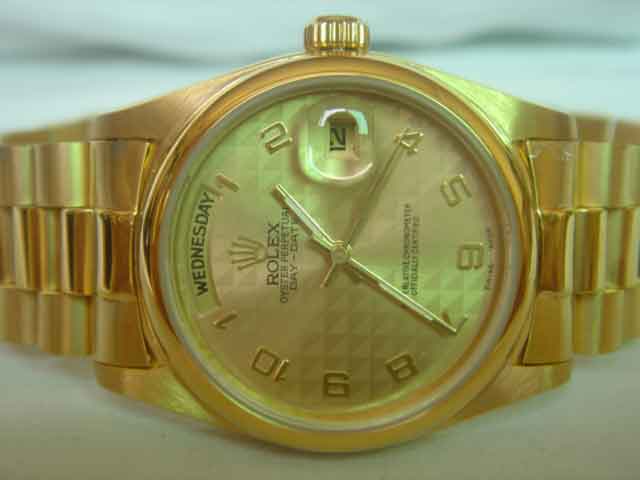
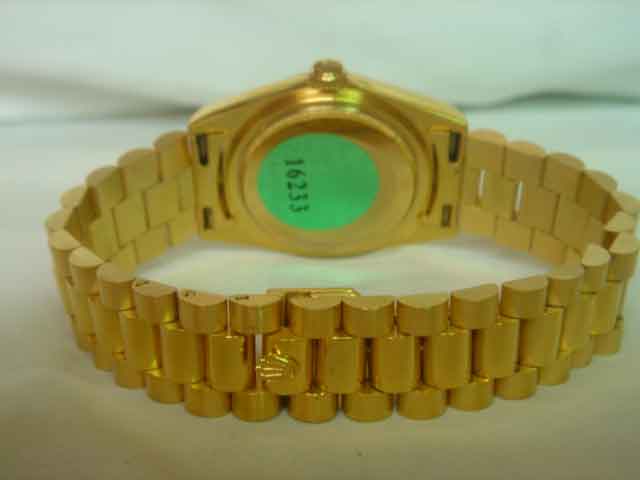
In an example of quirky marketing, some fakes are openly sold on counterfeiters’ Web sites. The site might include pictures of brand name watches, then pitch its own replicas at a fraction of the price.
click to enlarge (will open in a new
window)
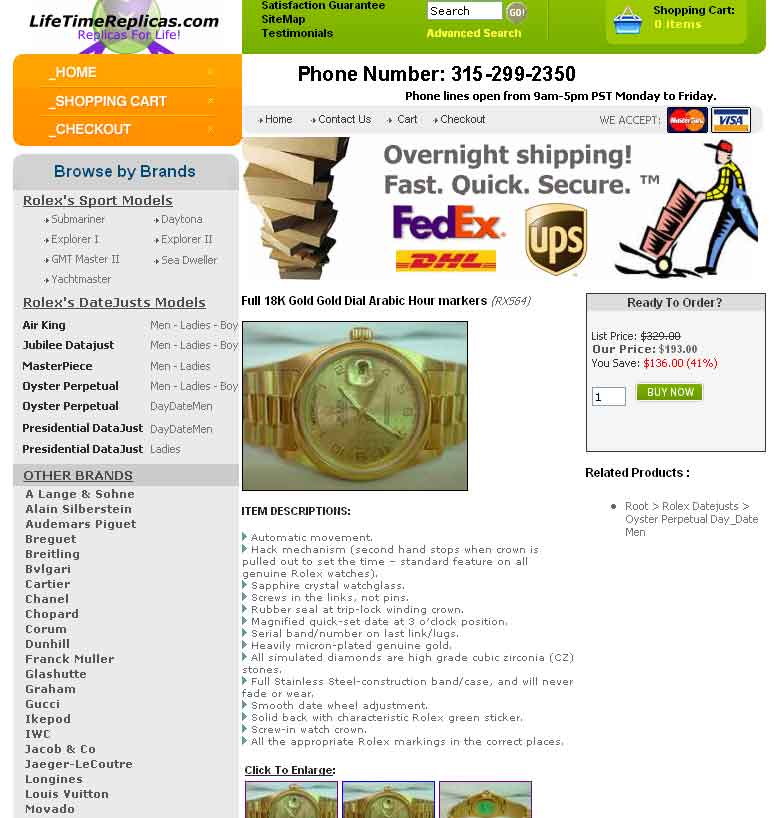
One counterfeit site ticks off the Rolex-like qualities its own fakes include, such as a sapphire crystal and screws in the links, rather than pins. It even boasts serial numbers, Rolex's magnified date at 3 c’clock position, the "characteristic Rolex green sticker" on the watch back, and "all the appropriate Rolex markings in the correct places." And at the left is a list of all the other brands the site offers fakes of!
click to enlarge (will open in a new
window)
Here, the buyer is well aware he's getting a knockoff. (But what does he tell the insurer?).
Who Makes the Fakes
It's a small world, as far as counterfeiters are concerned. In an increasingly sophisticated black market, watch components make their way to entrepreneurs around the globe. One Italian store owner purchased, through Georgian and Egyptian intermediaries, watches and watch parts that came from Hong Kong. Police found in the Hong Kong shipment metal plates and diagrams showing how to attach them to watch faces and how to forge a brand-name logo.
Closer to home, in October authorities arrested a Florida woman for operating a counterfeit watch business. Her rented storage unit held almost 2,000 brand-name fake watches, with a total estimated retail value of $8.5 million.
According to Interpol, the high returns have lured organized crime groups and terrorist groups into the trade, as well. A civil suit in New York involved a Vietnamese group that imported to the U.S. from China watch movements that cost 27 cents to make. After assembling the watches and adding fake logos, the group sold them to wholesalers for $12 to $20 each. The wholesalers resold them to street vendors and beauty parlors for $20 to $35 and to Internet dealers for even more. Consumers bought the watches for as much as $250.
Who's Being Fooled?
The shop owner-turned-counterfeiter in Italy used, as part of his defense, the argument that "a watch that sells for 100 euros ($120) is clearly not the real one, so the consumer isn't being tricked."
In the U.S., a private investigator for Rolex visited a local flea market and purchased two replica Rolex watches for $27 each. Federal authorities eventually seized the offending flea market booth and found 742 replica watches. The seller was indicted on two felony counts, but the District Court dismissed the indictment on the grounds that no person could reasonably believe that a $27 flea market watch was in fact a genuine Rolex.
The Court of Appeals subsequently reinstated the indictment. It turns out some of the customers were bringing the fake Rolexes to authorized Rolex dealers for service. The court took this as evidence that the customers did, in fact, believe the watches to be genuine.
FOR AGENTS AND UNDERWRITERS
Protect yourself from fraud! Regardless of whether or not the customer knows he's bought a fake, you should guard against insuring a counterfeit as the real thing.
Things to keep in mind:
- A logo is not enough!
- Fine watches are identified by model and serial number, which should
be given on the appraisal.
In addition, most manufacturers have separate model numbers for parts of the watch, such as the dial, bezel and band. All these numbers should be on the appraisal. - Any gems on the watch, and the metal of each watch part, should be described in the same detail as for a piece of gem jewelry. A picture is always helpful.
- The sales receipt should be from an authorized dealer of the brand. Most high-end manufacturers sell only through authorized dealers, and generally do not sell directly on the Internet.
- Fine watches not sold by an authorized dealer are considered by the company to be "second-hand" and do not carry warrantees.
- Not every jeweler is competent to appraise luxury watches, able to judge authenticity of the watch and all its parts, and to recognize non-authorized "after market" add-ons as well as out-and-out fakes.
- The appraisal you accept should be done by a dealer trained to authenticate that brand of watch, or by a Certified Insurance Appraiser™ who has the resources for obtaining proper authentication.
Many customers may not be aware that luxury watches bought from sources other than an authorized dealer may be counterfeit, despite any logos or trademarks. Insisting on complete information about the watch not only protects the insurer but is a service to the policyholder.
FOR ADJUSTERS
Though claims on luxury watches are relatively infrequent, they can be expensive. To guard against fraud:
- Check the appraisal for manufacturer, model and serial number, plus any other identifying information.
- The sales receipt is important evidence. If the seller is not an authorized dealer in that brand, the watch may be counterfeit.
If you suspect a watch is counterfeit, consider consulting a jewelry insurance expert to help resolve the issue.
Seek a replacement only from an authorized dealer for that brand. Do not be tempted to shop in the huge market that exists for watches with unauthorized, aftermarket add-ons (unless you are satisfied that the insured watch contained aftermarket add-ons).
©2000-2024, JCRS Inland Marine Solutions, Inc. All Rights Reserved. www.jcrs.com
Subscribe to Jewelry Insurance Issues
