
Emeralds
What's an emerald worth? How green is it? Why does an "enhancement" make it worth less? What's very wrong with emerald "Certificates"?
Jewelry, for all its beauty and romance, isn't necessarily a predictable investment. It's a commodity in the marketplace, and gem prices can go down as well as up. The fluctuations are generally invisible to consumer and insurer, but they determine the price of the purchase — and the value of the jewelry at any time in the future.
Emeralds are a case in point. Over the past decade, the wholesale price dipped precipitously for several years, and now is rising again.
Supplier's Per-Carat Cost
for 2-carat "Fine" Emeralds
1995 |
$5,200 |
1996 |
$4,800 |
1997 |
$3,800 |
1998 |
$3,100 |
1999 |
$2,400 |
2000 |
$2,000 |
2001 |
$2,000 |
2002 |
$2,000 |
2003 |
$2,200 |
2004 |
$2,700 |
2005 |
$3,300 |
How could the emerald you insured in 1995 lose over 60% of its value in just five years? Put another way, why were emeralds fresh out of the mines suddenly worth so much less?
According to one expert, several independent events contributed to a "decline in confidence" in the emerald market. For example, a sharp drop in the production of Colombia's emerald mines raised concerns about a reliable supply of fine-quality emerald. At the same time, Japan, a major buyer of fine gem material, was experiencing an economic slowdown. Meanwhile, the practice of clarity enhancement of emeralds with oils and polymers became more prevalent, and the major certifying labs had trouble finding a common standard for identifying and classifying the enhancing agents commonly used in various countries.
Now things are becoming more stabilized and new emerald mines are developing in Colombia. But such marketplace gyrations illustrate the importance of basing insurance premiums or settlements on a current valuation, reflecting current market prices.
Synthetic Emerald
Emerald is one of the most commonly synthesized gems. Malossi is the newest name on the block — the brand name synthetic emerald you may start seeing this year. But there are many producers. Synthetic gems typically sell for 5-10% the price of natural gems, so disclosure is essential.
Gem manufacturers may avoid using the word synthetic. Chatham, creator of some of the finest quality synthetic emeralds around, calls its gems Chatham Created Emeralds. Synthetic gems are sometimes described as grown or cultured. A brand name may also identify a gem as synthetic.
A knowledgeable appraiser will recognize synthetic gems and report this information on the appraisal.
Clarity Enhancements
Fracture-filling is an easy and inexpensive treatment widely used on emeralds. To make an inferior gem look clearer and more valuable, technicians fill in any fractures in the stone with some other material. Literally thousands of products are used for the filling, ranging from 3-in-1 oil to proprietary formulas.
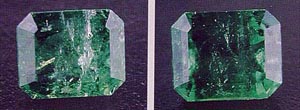
Emerald before and after fracture-filling
If non-gem material is found in the stone, technicians may use a laser to drill a channel to the inclusion and remove it. Then they fill in both the fracture and the channel. Some fillers may not be stable or durable.
These treatments change only the gem's appearance (to the unaided eye), not its value. Flaws that have been fracture-filled can readily be seen under a microscope, so gemologists recognize the stone as being inferior in quality. Whether the flaw is visible or not, an emerald with a fracture has an inherent weakness making it more susceptible to damage.
Fracture filling is so commonplace in the emerald market that stones NOT so treated are worth considerably more than treated stones. So the appraisal should either note the treatments performed on the emerald or explicitly state that the stone is untreated.
Read more about fracture filling and about an insurance claim involving a fracture-filled emerald.
Oiling is an enhancement routinely done to improve the appearance of emeralds. A colorless oil penetrates into voids and fissures that reach the surface. It does not harm the gem, though temperature changes and chemicals used in cleaning may affect the stability of the treatment. All enhancements should be disclosed, both verbally and on the sales receipt and appraisal.
The Emerald Certificate
Certificates for diamonds have become commonplace, and that may be happening with colored gems, too. However, emerald certificates currently available are not of much use to insurers. The main reason is that emerald reports basically ignore the single most important criterion in valuing colored gems — their color!
To accurately document the subtlety of an emerald's color, the appraiser must rely upon precise gemological language, using terms specified by the Gemological Institute of America (GIA) and widely accepted throughout the world. Color is described according to three criteria:
- Tone – the lightness or darkness of a color, expressed as one of the nine levels of tone ranging from very very light to very very dark.
- Saturation – the degree to which a color departs from a neutral (gray) sensation, expressed in terms such as brownish, grayish, moderately strong, and vivid.
- Hue – what we think of as color, but expressed in one of the 31 specified gemstone hues, such as slightly greenish blue.
An emerald's color, for example, might be described as Medium Light (tone), Very Slightly Grayish (saturation), and very slightly bluish Green (hue). A description that gives an emerald's color as merely "green" is worthless.
Sad to report, NONE of the labs currently issuing emerald reports includes precise color descriptions based on the widely recognized tone-saturation-hue system — although fully 50% of an emerald's value is determined by its color! Not even GIA itself, which developed the system and teaches it, uses it on color stone reports.
For such information, insurer and jewelry owner must rely on an appraisal by a gemologist trained and experienced with colored gemstones.
Similarly, none of the lab reports — including GIA's — describes an emerald's clarity according to the widely recognized GIA system. A lab either follows its own grading classification (with no key as to how to interpret the grade), or omits clarity altogether. Again, one must rely on a detailed appraisal for clarity information based on the GIA scale.
Emeralds (like some other colored gems, but unlike diamonds) may derive some of their value from where they were mined. Therefore, country of origin is also important. Most lab reports omit this information as well.
Read more about colored stone certificates.
Because emerald certificates, or reports, are so lacking in critical information, the need for a reliable appraisal by a credentialed appraiser is particularly important.
Appraisal & Appraiser
Too often, appraisals for colored gemstones contain only brief and vague descriptions of color, as though it didn't much matter. However, the gemological terms for gem color are standardized and specific. Appraisals should always describe color in terms of tone, saturation and hue.
Appraisals on colored gems typically fall short in all crucial information. A study of insurance appraisals exposed the low percentage of appraisals that include necessary details.
Insurance Appraisals for Colored Gem Jewelry
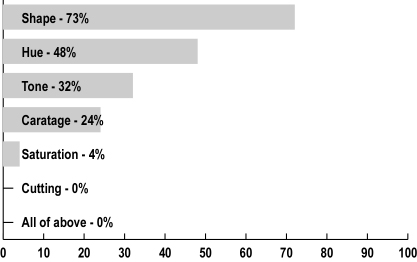
The appraisal should also give the gem's clarity, treatments, and origin, and should state whether the gem is synthetic.
A JISO 78/79 appraisal (formerly ACORD 78/79), the insurance industry's standard for detail and accuracy, carries this essential information.
Not every jeweler, nor even every trained gemologist, is competent to appraise emeralds. A reliable appraiser of emerald jewelry is a jeweler experienced in buying and selling colored gems, familiar not only with market values but also with scams, synthetics, treatments, brand names and other information specific to colored gems. He or she should be a Graduate Gemologist, preferably a Certified Insurance Appraiser™.
FOR AGENTS & UNDERWRITERS
Never insure emerald jewelry based only on a "certificate," which leaves out basic information.
Be sure the appraisal includes information on the emerald's
- color, in terms of hue, tone and saturation (because color, precisely described, accounts for as much as 50% of an emerald's value);
- clarity, following the GIA's clarity scale;
- treatments or enhancements, especially fracture-filling (breakdown of a fracture-filling treatment is not considered damage for which the insurer is liable); and
- origin.
A JISO 78/79 appraisal, by a Graduate Gemologist and Certified Insurance Appraiser™, gives complete and reliable information.
Be sure the appraisal is recent, because the value of gems can fluctuate dramatically.
FOR CLAIMS
Terms such as lab-grown, created, and cultured mean that the gem is synthetic. Synthetic emeralds have a far lower value than natural ones.
A brand name on an appraisal or other documents may indicate a gem is synthetic, or it might yield other information about valuation. Consider consulting a jewelry insurance expert for help interpreting brand names.
Breakdown of a fracture-filling treatment is not considered damage for which the insurer is liable. Fracture-filling of emeralds is so commonplace that all damaged jewelry should be examined in an independent gem lab by a Certified Insurance Appraiser™.
It is wise to suspect fracture-filling if:
- damage appeared after the jewelry had been cleaned or the stone reset. (Heat or pressure often disturb the fracture-filling treatment.)
- the policyholder's purchase price seems unusually low for the stated quality of the piece. (He may have gotten "the good deal" because the jewelry was low quality to begin with.)
©2000-2025, JCRS Inland Marine Solutions, Inc. All Rights Reserved. www.jcrs.com
Subscribe to Jewelry Insurance Issues
